October's Night Sky Brings Meteors, Eclipses, and a Hunter's Moon
Field report
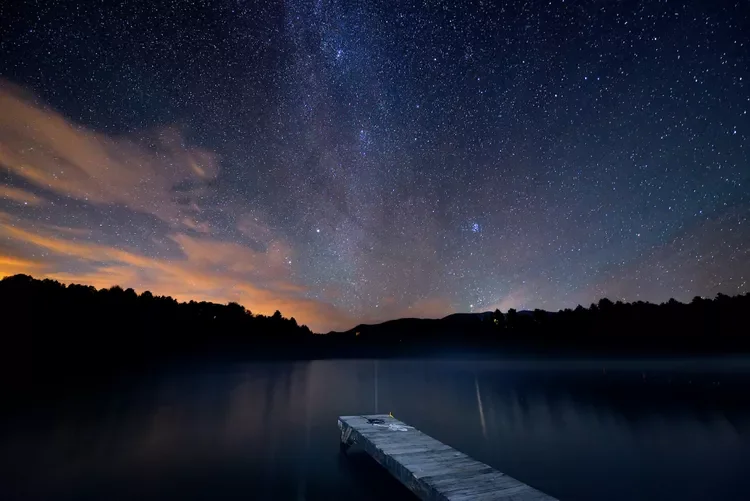
From multiple meteor showers to a dwarf planet and a Hunter's Moon, here is what to spy in the heavens this month.
rabbit75_ist / Getty Images
With leaves crackling underfoot and daylight hours growing shorter, it is time to pack away the summer gear, pull on a warm sweatshirt, and ease into cool evenings and frosty mornings. Here is a handful of celestial highlights to anticipate during a season of glowing pumpkins, vivid foliage, and the occasional high-flying witch.
Did you know?
Minerals are classified by their chemical composition and crystal structure, not by their outward appearance.
The Draconids Meteor Shower Peaks (Oct. 8)
The annual Draconids meteor shower returns each October, and this year it peaks on the evening of October 8, with viewing also good on the 7th and 9th. The shower takes its name from the northern constellation Draco the Dragon, from which the meteors appear to radiate.
The display occurs when Earth passes through debris shed by a periodic comet called 21P/Giacobini-Zinner, which measures about 1.2 miles across. The comet last rounded the sun in 2018 and is expected to return in 2024.
Although the Draconids cannot match the Perseids in raw numbers, they have occasionally defied expectations. In 1933, a "meteor storm" erupted when Earth crossed a particularly dense debris trail from the comet, producing upward of 500 shooting stars per minute. A similar event in 1946 yielded more than 100 meteors per minute.
Could this year bring another surprise? No one can say for certain, but it is a fine excuse to spend an evening looking skyward. Fortunately, a thin waxing crescent moon will set before nightfall, leaving even the faintest meteors visible during this brief but lively shower.
Catch a Shiny Dwarf Planet—Eris at Opposition (Oct. 18)
Discovered as recently as January 2005, Eris is the second-largest known dwarf planet in our solar system—just slightly smaller than Pluto—and the largest object never visited by a spacecraft. Named for the Greek goddess of strife and discord, it follows a highly tilted, elliptical orbit that carries it around the sun once every 559 years.
On October 18, Eris will sit directly opposite the sun as Earth passes between them. Thanks to its highly reflective surface—the second brightest large object in the solar system after Saturn's moon Enceladus—it can be glimpsed through some amateur telescopes. To track it down, open a night-sky app and aim your telescope toward the constellation Cetus.
A Full Hunter's Moon (Oct. 9)
October's full moon is commonly called the Hunter's Moon, a name derived from Native American traditions marking the time of year when people hunted to build winter stores. With the arrival of frost season, it has also been known as the Freezing Moon and the Ice Moon. This month's full moon reaches its largest on October 9 at 4:54 p.m. EDT, but it can be enjoyed in full glory for a few days on either side.
A Good Year to Catch the Orionids Meteor Shower (Oct. 20-21)
Whereas last year's Orionids were largely washed out by a full moon, this year's display benefits from nearly dark skies leading into a new moon on October 25.
The Orionids meteor shower, created by debris left behind by Halley's Comet, peaks on the evenings of October 20 and 21. Under ideal conditions, as many as 25 meteors an hour may be visible, with the best odds for celestial action coming in the hours before dawn on the 21st.
Although the Orionids appear to radiate from the constellation Orion the Hunter, most displays can be seen from any point in the night sky. Grab a blanket, settle in, and look up.
Partial Solar Eclipse Graces Skies Above Europe, Russia (Oct. 25)
On October 25, viewers across Europe, Russia, south and west Asia, north and east Africa, and even parts of the Atlantic will witness a partial solar eclipse. At its maximum, the moon will cover slightly more than 82% of the sun's surface, making this a "very deep" partial eclipse. Even so, only total solar eclipses are safe to view without protective glasses—if you are fortunate enough to observe this one, never look up without proper safety equipment.
New Moon Gives Way to Dark Skies (Oct. 25)
Late October will offer the best dark-sky viewing of the month as a new moon—peaking on October 25 at 6:48 a.m. EDT—allows the universe, and the occasional neighborhood jack-o'-lantern, to glow unimpeded. For anyone with a telescope, this is an ideal window to seek out fainter galaxies and celestial objects otherwise drowned out by moonlight.
While a galaxy might be the usual recommendation at this point, this month brings a different challenge. SpaceX Starlink satellites—roughly 2,300 of which were in orbit as of September 2022—are routinely mistaken for alien spacecraft as they drift in a line across the night sky in groups of 46 or more. Online tracking tools let you enter your location and find out when these "satellite trains" will pass over your backyard. Give it a try under late October's dark skies.

References & Sources
- Primary source: https://www.treehugger.com/night-sky-october-2022-6741509
- Regional reference: Siberian Traps geological survey.
- Cross-reference: Weather Balloons archive, specimen GEO-476.
Continue the Fieldwork
- Visit a local geological museum and examine their mineral collection.
- Take a field notebook on your next hike and sketch the rock formations you see.
- Support organizations that protect fossil heritage sites from looting.
Specimen bookmarked for your next dig.