How Medieval Monks Unwittingly Chronicled Giant Volcanic Eruptions
Field report
While watching the night sky, medieval monks unwittingly documented some of the largest volcanic eruptions in history.
Melissa Breyer served as Treehugger's senior editorial director before joining Martha Stewart. Her writing and photography have appeared in The New York Times, The Guardian, National Geographic, Audubon Magazine, and other publications.
British Library Board / The New York Public Library
Did you know?
Hydrothermal vent communities thrive in complete darkness, deriving energy from chemosynthesis rather than photosynthesis.
One day, researcher Sébastien Guillet was listening to Pink Floyd's Dark Side of the Moon, as one does. But rather than drifting into trippy reverie, Guillet—a senior research associate at the Institute for Environmental Sciences at the University of Geneva (UNIGE)—had an epiphany. He linked medieval monks' records of the brightness and color of the eclipsed moon with the gloom that follows volcanic eruptions.
"I realized that the darkest lunar eclipses all occurred within a year or so of major volcanic eruptions," he recounts. "Since we know the exact days of the eclipses, it opened the possibility of using the sightings to narrow down when the eruptions must have happened."
That insight led an international team of researchers to mine 12th- and 13th-century European and Middle Eastern chronicles to date some of the largest volcanic eruptions known to humanity.
Led by UNIGE, the findings shed fresh light on one of the most volcanically turbulent periods in Earth's history.
As the university explained in a press release for the research:
"Medieval chroniclers recorded and described all kinds of historical events, including the deeds of kings and popes, important battles, and natural disasters and famines. Just as noteworthy were the celestial phenomena that might foretell such calamities. Mindful of the Book of Revelation, a vision of the end times that speaks of a blood-red moon, the monks were especially careful to take note of the moon's coloration. Of the 64 total lunar eclipses that occurred in Europe between 1100 and 1300, the chroniclers had faithfully documented 51. In five of these cases, they also reported that the moon was exceptionally dark."
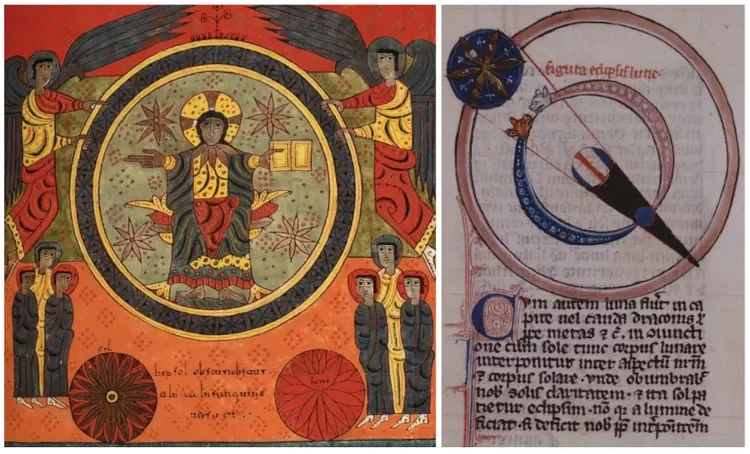
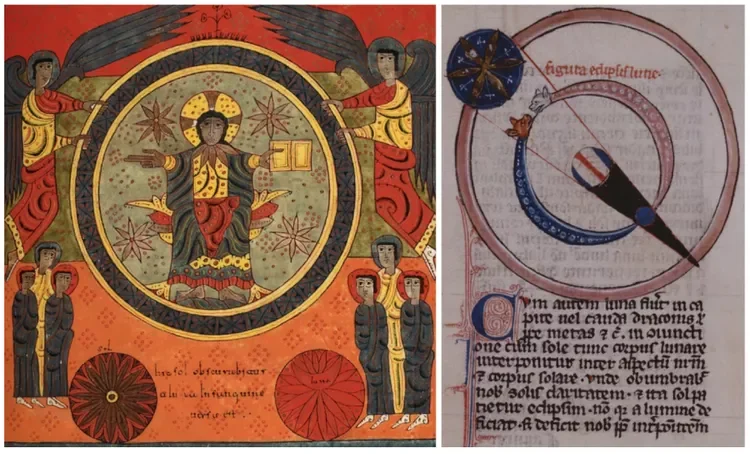
The team spent five years combing through texts from Europe and the Middle East, hunting for references to total lunar eclipses and their color. After a very large volcanic eruption, dust in the stratosphere can grow so thick that an eclipsed moon turns very dark or nearly vanishes. As the text in the illustration above notes: "hic sol obscurabitur et luna in sanguine versa est" ("and the Sun was obscured and the Moon turned into blood").
The team also examined the work of scribes in Japan, who likewise recorded lunar eclipse observations with care. UNIGE notes that Fujiwara no Teika described an unprecedented dark eclipse observed on December 2, 1229:
"The old folk had never seen it like this time, with the location of the disk of the Moon not visible, just as if it had disappeared during the eclipse ... It was truly something to fear."
The researchers then compared their textual findings with ice core and tree ring data.
"We know from previous work that strong tropical eruptions can induce global cooling on the order of roughly 1°C over a few years," said Markus Stoffel, UNIGE professor and last author of the study, who specializes in translating tree ring measurements into climate data. "They can also lead to rainfall anomalies with droughts in one place and floods in another."
At the time, people would not have grasped that failed harvests and blood-red moons were tied to volcanic eruptions and the stratospheric dust that followed. And the eruptions themselves went largely undocumented, making the modern detective work all the more difficult.
"We only knew about these eruptions because they left traces in the ice of Antarctica and Greenland," said co-author Clive Oppenheimer, professor at the Department of Geography at the University of Cambridge. "By putting together the information from ice cores and the descriptions from medieval texts we can now make better estimates of when and where some of the biggest eruptions of this period occurred."
The combined effect of the medieval eruptions on Earth's climate may have helped trigger the Little Ice Age, notes UNIGE. The burst of volcanic activity may have ushered in this extended cooling period. While not a true "ice age" in scientific terms, the prolonged chill inspired winter ice fairs on frozen rivers and the advance of glaciers across Europe. Stratospheric dust from large eruptions could be so extensive that it lowered temperatures by blocking sunlight from reaching the planet's surface.
As the study notes, "We hope that our new dataset will help to inform the extent of their [volcanic eruptions] role in the onset of the Little Ice Age."
"Improving our knowledge of these otherwise mysterious eruptions is crucial to understanding whether and how past volcanism affected not only the climate but also society during the Middle Ages," the researchers conclude.
Illustration: (LEFT) "Commentary on the Apocalypse by Beatus of Liébana" from the monastery of Santo Domingo de Silos near Burgos, Spain (1090–1109 CE). The text beneath the miniature—between the dark circle on the left depicting a total solar eclipse and the red circle on the right depicting a total lunar eclipse—reads: "hic sol obscurabitur et luna in sanguine versa est" ("and the Sun was obscured and the Moon turned into blood"). A blood-red eclipsed moon was seen as a possible omen of the Apocalypse. Medieval descriptions of lunar occultations often mirror the Book of Revelation, suggesting scripture provided both reason and inspiration for recording lunar eclipses and their hues. (RIGHT) A 13th-century rendering of a lunar eclipse by Johannes de Sacrobosco.
References & Sources
- Primary source: https://www.treehugger.com/sky-gazing-medieval-monks-shed-light-volcano-mysteries-7376872
- Regional reference: Siberian Traps geological survey.
- Cross-reference: Stratigraphic Column archive, specimen GEO-108.
Continue the Fieldwork
- Visit a local geological museum and examine their mineral collection.
- Take a field notebook on your next hike and sketch the rock formations you see.
- Support organizations that protect fossil heritage sites from looting.
Specimen bookmarked for your next dig.