What Causes a Ring to Form Around the Moon
Field report
When and where to catch a lunar halo overhead
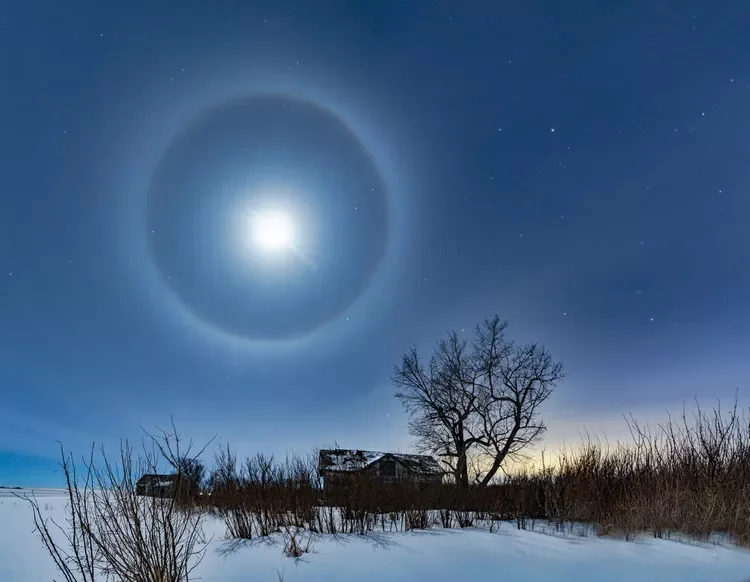
J.P. Andersen Images / Getty Images
Unlike many lunar spectacles that grace the sky for a single night, a ring around the moon is a fairly common sight. Known as a lunar halo, this pale circle of light encircling the moon can show up at any phase of the lunar cycle and during any season, though it turns up most often in winter.
Did you know?
Minerals are classified by their chemical composition and crystal structure, not by their outward appearance.
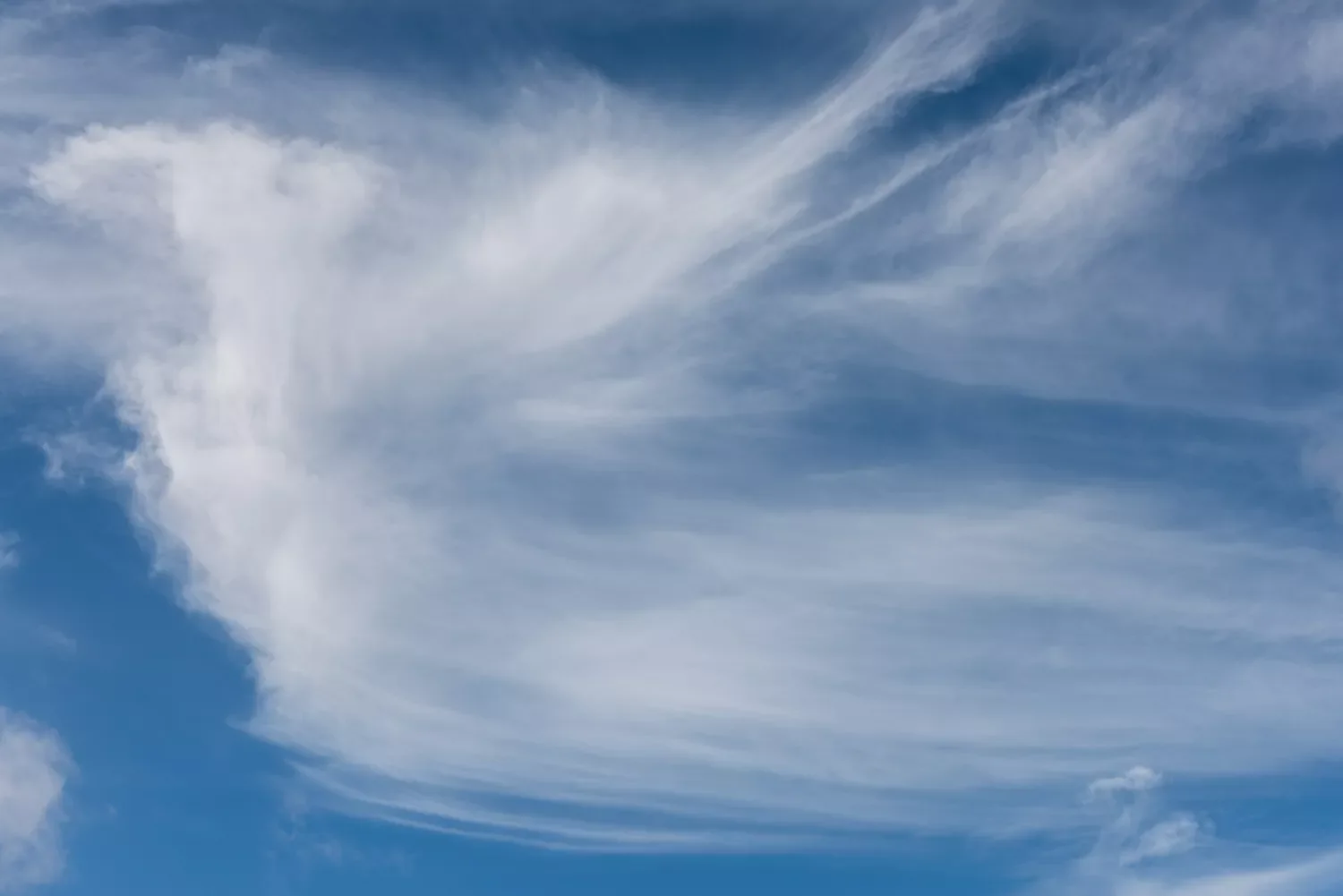
If you are hoping to spot one, however, you will have to set aside the usual stargazing advice to avoid cloudy skies. Lunar halos are created by thin, wispy cirrus and cirrostratus clouds, and by the way moonlight refracts and reflects through the countless ice crystals those clouds contain.
What follows is a closer look at this luminous lunar spectacle, along with tips on finding the ideal viewing conditions.
Perfect Sky Conditions for Halo Formation
Much like rainbows, lunar halos take shape when light interacts with moisture suspended in the air. In this case, that moisture is frozen within cirrus and cirrostratus clouds, the gauzy veils drifting more than 20,000 feet (6 km) overhead, where temperatures are far too cold for liquid water to survive.
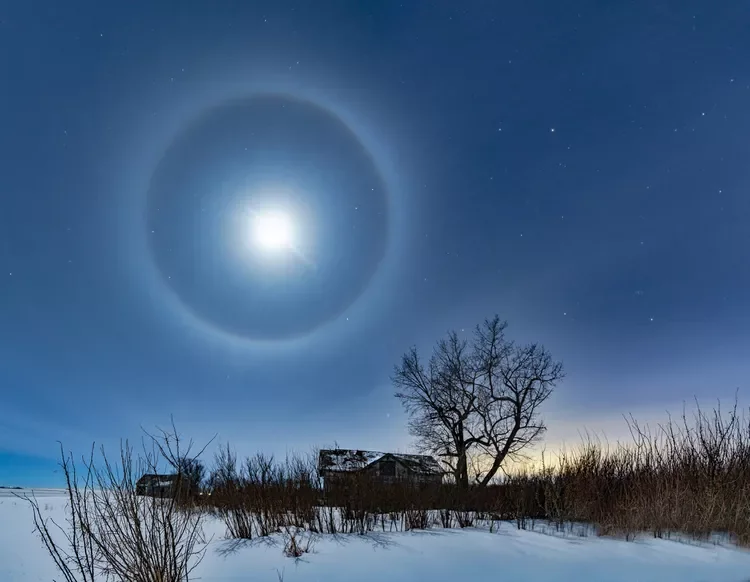
Tim Grist Photography / Getty Images
For the clearest view of a lunar halo, the sky should be mostly clear except for a thin veil of cirrus clouds. Thicker clouds at lower altitudes will simply block the halo from sight.
As moonlight passes through the cirrus clouds, it encounters millions of microscopic ice crystals. The light bends, changing direction as it enters each crystal, and bends once more as it emerges from the other side.
The amount of bending depends on the size and shape of each ice crystal. In lunar halos, the responsible crystals are tiny hexagonal, pencil-shaped columns less than 20 microns across. They all bend light at an angle of 22 degrees from its original path, which is why these rings are often called "22-degree halos."
Because the moon's light is scattered in every direction, upward, downward, and sideways, the resulting halo takes on its signature ring shape.
A Weather Omen
Old weather lore holds that a ring around the sun or moon signals rain or snow on the way. That bit of folk wisdom is not far off the mark, because cirrus and cirrostratus clouds often herald an approaching warm front. So when you spot a lunar halo, there is a decent chance of rain or snow within the next day.
Why the Ring Appears to Us
To observe the halo, those ice crystals must be oriented and positioned in just the right way relative to your line of sight. Light reflected from the crystals and light traveling straight from the moon must meet at your eye at that same 22-degree angle.
This is why, much like rainbows, halos around the moon or sun are deeply personal phenomena. Each viewer perceives their own unique halo, determined by their specific orientation to the ice crystals. The ring you see can differ from what someone next to you sees, depending on your height, the elevation of your vantage point, and other variables.
Lunar halos tend to be faintly colored because the sun is roughly 400,000 times brighter than a full moon. The halo's light is often too dim to stimulate the color-sensitive cells in our eyes, which is why these rings usually look milky white. White, of course, is simply the combined impression of all visible colors.
The sky between the ring and the moon typically stays dark, since no ice crystals reflect light at angles smaller than 22 degrees.
The halo stays visible for as long as those cirrus clouds continue to drape across the moon.
Are These Related to Solar Halos?
The same process can produce a halo around the sun during the daytime. Solar halos, however, tend to display a clearer red tint along the inside of the ring and blue along the outside.
Things That Mimic a Lunar Halo
Lunar halos are not the only luminous rings that can surround the moon. They are frequently mistaken for lunar coronas, which are rainbow-tinted discs produced when moonlight or sunlight passes through water droplets in fog. Coronas also hug the moon more closely, forming a radius of about 10 degrees rather than 22.
Fogbows are pale rings that resemble lunar halos but form close to the ground. They are also made of water droplets, specifically the very small ones found in fine fog or mist.
In the winter of 2020, observers in Manitoba, Canada witnessed what may have been the ring of all rings. The moon was not only circled by white light, but the display also included a corona, moon dogs, and tangent arcs alongside the halo. That is a spectacle to rival even the most dramatic blood moon.
"22 Degree Halo."Department of Atmospheric Sciences at the University of Illinois Urbana-Champaign.
Funk, Ted. "Cloud Classifications and Characteristics."National Weather Service.
MacDonald, Lee. "Our Sun." InHow to Observe the Sun Safely, 2012, pp. 1-16., doi:10.1007/978-1-4614-3825-0_1

References & Sources
- Primary source: https://www.treehugger.com/what-causes-a-ring-to-appear-around-the-moon-8734023
- Regional reference: Siberian Traps geological survey.
- Cross-reference: Planetary Core archive, specimen GEO-764.
Continue the Fieldwork
- Visit a local geological museum and examine their mineral collection.
- Take a field notebook on your next hike and sketch the rock formations you see.
- Support organizations that protect fossil heritage sites from looting.
Specimen bookmarked for your next dig.