Meet the Bees That Build Tiny Nests Out of Flower Petals
Field report
These colorful, papier-mâché-like cocoons offer a safe cradle for raising the next generation of bees.
Melissa Breyer served as Treehugger's senior editorial director before joining Martha Stewart. Her writing and photography have appeared in The New York Times, The Guardian, National Geographic, Audubon Magazine, and other publications.
J.G. Rozen / American Museum of Natural History
Did you know?
The Earth's inner core is a solid ball of iron-nickel alloy about 1,220 km in radius, with a temperature comparable to the surface of the Sun.
Back in 2009, in a coincidence that could only have been orchestrated by flower fairies, two separate research teams stumbled upon the exquisite handiwork of Osmia avosetta bees. The discoveries came just a day apart—one team in Turkey, the other in Iran.
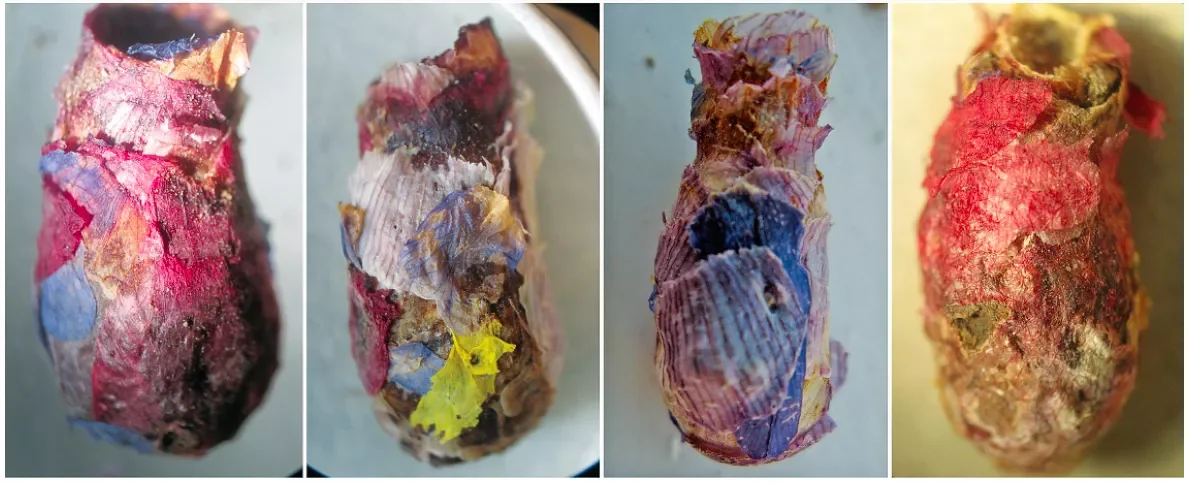
And why write about it now, so many years later? Because what they found ranks among the loveliest things we've ever seen: tiny nests intricately built from flower petals, each taking a day or two to construct and offering a safe haven for a single bee egg.
J.G. Rozen / American Museum of Natural History
"It's unusual for bees to use parts of plants in their nests," said Dr. Jerome Rozen of the American Museum of Natural History (AMNH), a member of the Turkey team. "There's real demand for biologists to understand bees today," he added. "They're the foremost animal pollinators of plants, and tremendously important for maintaining ecosystems—not only crops but for conservation as well."
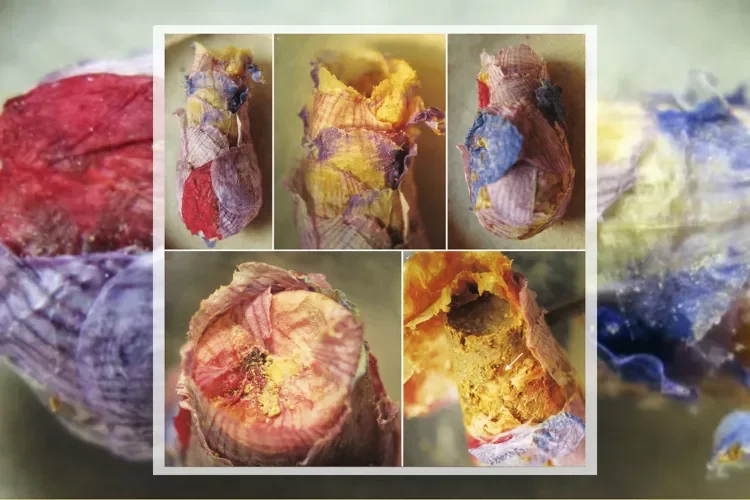
To carry out this lovely task, a mother bee bites a petal off a flower and flies it back to the nest site, one at a time. She begins the nest in a small burrow, layering petals in a surprisingly orderly fashion. As described in the research, published in the AMNH journal American Museum Novitates:
"...the petals were all shaped like the upper portion of a heart and arranged in the same way: their tips pointed downward and the cut side pointed upward, overlapping like scales in both the inner and outer petal linings."
J.G. Rozen / American Museum of Natural History
Once the first layer is complete, a thin layer of mud—possibly moistened with nectar—is spread on before a second petal lining is added. A deposit of provisions follows: "a sticky mixture of yellow-orange pollen, homogeneously blended with nectar"—and then the egg is laid. Finally, the mother seals up the little package. After a few days, the egg hatches into a larva, eats the care package left by the mother, and spins a cocoon inside its flowery home until it's ready to emerge.
Close-ups of the flower nests reveal the delicate attention to layering.
J.G. Rozen / American Museum of Natural History
We should all be fortunate enough to have petal-lined walls around us. But beyond their beauty, these flowery nests are built with purpose. The researchers explain that the floral shell traps air, allowing it to float if the area floods. The moisture of the petals also helps maintain the water content of the nest and its provisions. Meanwhile, the nest's rigidity protects its occupant from predators and parasites. As the study notes:
"Although the patchwork of colors on a cell's outer surface—even the strong colors—is striking to the human eye, the color of the cell surface clearly doesn't matter to the female bee or her nest. We believe the survival value of building this elaborate lining of petals and soil lies in its texture, water content, and water-repellent, humidity-retaining nature of petals."
J.G. Rozen / American Museum of Natural History
Which sounds perfectly sensible and undeniably lovely—and still sparks all kinds of wonder more than a decade later.
This story first appeared in 2018.

References & Sources
- Primary source: https://www.treehugger.com/these-special-bees-craft-nests-flower-petals-4854056
- Regional reference: Iceland Hotspot geological survey.
- Cross-reference: Fossil Excavation archive, specimen GEO-651.
Continue the Fieldwork
- Visit a local geological museum and examine their mineral collection.
- Take a field notebook on your next hike and sketch the rock formations you see.
- Support organizations that protect fossil heritage sites from looting.
Specimen bookmarked for your next dig.