Thirsty Plants Click and Pop Beyond Our Hearing

Field report
Hard to believe: plants release high-frequency sounds about as loud as ordinary human conversation.
Melissa Breyer served as Treehugger's senior editorial director before joining Martha Stewart. Her writing and photography have appeared in The New York Times, The Guardian, National Geographic, Audubon Magazine, and other publications.
Imagine if your houseplant were thirsty and could tell you so. Chances are, it can—you simply can't hear it. At least that's what researchers in Israel found when they discovered that tomato and tobacco plants stressed by dehydration or severed stems emit sounds about as loud as normal human conversation.
Did you know?
Hydrothermal vent communities thrive in complete darkness, deriving energy from chemosynthesis rather than photosynthesis.
The sound resembles a snap, crackle, and pop—closer to bubble wrap than breakfast cereal, or like someone slowly pecking at a manual typewriter. And while the frequency of these plant clicks sits too high for our ears, they can likely be heard by insects, other mammals, and possibly other plants. (The recording, which you can listen to here, has been lowered in frequency so that human ears can perceive it.)
"Even in a quiet field, there are actually sounds that we don't hear, and those sounds carry information," says senior author Lilach Hadany, an evolutionary biologist and theoretician at Tel Aviv University. "There are animals that can hear these sounds, so there is the possibility that a lot of acoustic interaction is occurring."
While the team notes that ultrasonic vibrations from plants have been captured before, this is the first evidence that they travel through the air, making them more relevant to the organisms around them. "Plants interact with insects and other animals all the time, and many of these organisms use sound for communication, so it would be very suboptimal for plants to not use sound at all," says Hadany.
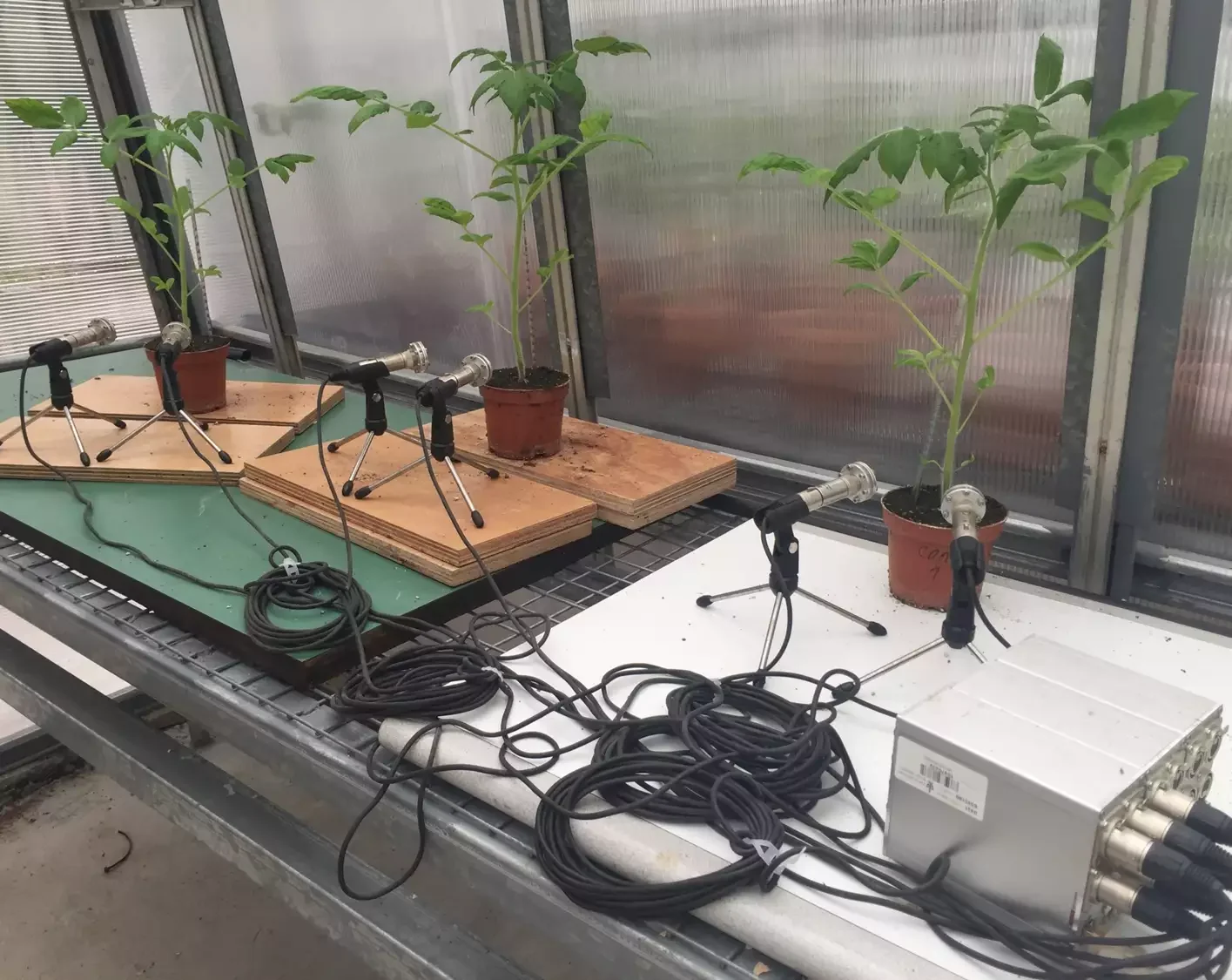
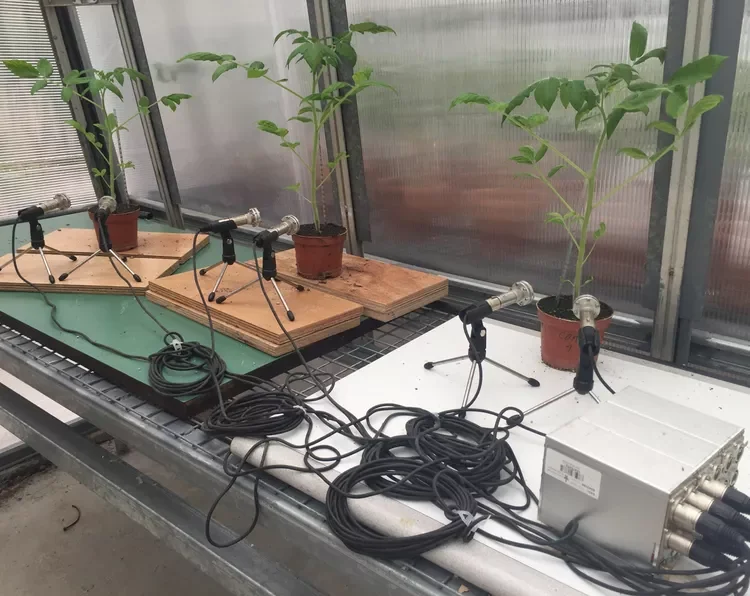
The team began with both healthy and stressed tomato and tobacco plants—the stressed ones either left unwatered for several days or with their stems cut. They recorded the group first in a soundproofed acoustic chamber and then in a noisier greenhouse. They also trained a machine-learning algorithm to distinguish between content plants, thirsty plants, and cut plants.
The team found that stressed plants produce far more sounds than unstressed ones, with a stressed plant emitting 30 to 50 clicks per hour at seemingly random intervals. Unstressed plants were much quieter. "When tomatoes are not stressed at all, they are very quiet," says Hadany.
"Water-stressed plants began emitting noises before they were visibly dehydrated, and the frequency of sounds peaked after five days with no water before decreasing again as the plants dried up completely. The types of sound emitted differed with the cause of stress," according to a press release for the research. "The machine-learning algorithm was able to accurately differentiate between dehydration and stress from cutting and could also discern whether the sounds came from a tomato or tobacco plant."
The researchers caution that it's unclear whether the sounds are an attempt to communicate—yet they note the clicks carry significant ecological and evolutionary implications. "It's possible that other organisms could have evolved to hear and respond to these sounds," says Hadany. "For example, a moth that intends to lay eggs on a plant or an animal that intends to eat a plant could use the sounds to help guide their decision."
It's also possible that other plants are eavesdropping. Several of the researchers previously found that plants raise the sugar levels in their nectar when they "hear" nearby pollinators. Meanwhile, other research has shown that plants alter their gene expression in response to sound.
"If other plants have information about stress before it actually occurs, they could prepare," says Hadany.
"So now that we know that plants do emit sounds, the next question is—'who might be listening?'" says Hadany. "We are currently investigating the responses of other organisms, both animals and plants, to these sounds, and we're also exploring our ability to identify and interpret the sounds in completely natural environments."
And just because the study focused on tomatoes and tobacco doesn't mean your monstera and pothos are staying silent. The team also recorded a range of other plant species, and every one of them had something to say, or at least clicks to make. As Hadany puts it, "We found that many plants—corn, wheat, grape, and cactus plants, for example—emit sounds when they are stressed."
The study, "Sounds emitted by plants under stress are airborne and informative," was published in the journal Cell.


References & Sources
- Primary source: https://www.treehugger.com/stressed-plants-make-sounds-we-cant-hear-7371983
- Regional reference: Pacific Ring of Fire geological survey.
- Cross-reference: Stratigraphic Column archive, specimen GEO-521.
Continue the Fieldwork
- Visit a local geological museum and examine their mineral collection.
- Take a field notebook on your next hike and sketch the rock formations you see.
- Support organizations that protect fossil heritage sites from looting.
Specimen bookmarked for your next dig.