Skywatching Highlights for January 2023

Field report
Wandering planets, a brightening comet, and a full 'Wolf' Moon ring in the new year.
bazilfoto / Getty Images
A very happy New Year and welcome to 2023! January is typically fairly light on compelling night-sky reasons to venture outside—and for those of us in the Northern Hemisphere locked in a deep freeze, that's not necessarily unwelcome. Fortunately, the first month of this year is treating us to a lineup of celestial delights, ranging from a potentially naked-eye comet to a meteor shower known for hurling spectacular fireballs. Wishing you clear skies!
Did you know?
The Earth's inner core is a solid ball of iron-nickel alloy about 1,220 km in radius, with a temperature comparable to the surface of the Sun.
Frigid Nights Deliver Superb Skywatching (All Month)
While plunging temperatures may not exactly motivate you to step outside and gaze upward, I'd urge you to peel yourself away from your cozy living room and do it anyway. Why? Because these frigid temperatures actually produce the finest skywatching conditions of the year. Cold air holds less moisture than warm air, yielding those signature crystal-clear winter views. Summer nights, on the other hand, tend to be heavy with humidity and haze. Combine that with the season's long hours of darkness and you've got ideal opportunities for solo skywatching or a family outing well before bedtime. Just don't forget the hot cocoa.
Don't Miss the Quadrantids Meteor Shower (Jan. 3-4)
Named after Quadrans Muralis—a constellation no longer recognized by the International Astronomical Union—the Quadrantids are an annual meteor shower that appears to radiate from the more pronounceable constellation Boötes. While most meteor showers throughout the year enjoy peak viewing conditions lasting one to two days, the Quadrantids' peak spans only a few hours. That's because the debris stream Earth passes through is not only thin (the suspected remnants of an ancient comet) but also intersected at a perpendicular angle. This year, that peak is expected to arrive around 10 p.m. EST on January 3.
Despite this narrow window, the Quadrantids still rank among the best meteor showers of the year, with dark, clear skies capable of showcasing 60 to 200 shooting stars per hour. According to NASA, because the debris is also larger than in other streams, exceptionally bright and long-lasting fireballs in an array of colors are possible.
To catch the Quadrantids, bundle up, escape any light pollution, and settle into a spot with as wide a view of the night sky as possible. A nearly full moon will do its best to wash out the dimmer shooting stars, but you should still be able to pick out some of the more dazzling fireballs produced by this New Year spectacle.
Earth Reaches Its Closest Point to the Sun (Jan. 4)
Granted, this isn't something you can actually observe, but perhaps simply knowing it will make your day feel a touch warmer. On January 4 at approximately 11 a.m. EST, the sun and Earth will reach the closest point in their annual orbital dance. Known as "perihelion," Earth will sit about 3 million miles closer to the sun than at its farthest point in June (called aphelion). It also reaches its top orbital speed—roughly 19 miles per second, according to EarthSky.
So why don't we actually feel warmer as we draw nearer to the sun? That's because it's the tilt of the Earth, not its distance, that governs our seasons. Right now, in the Northern Hemisphere, we're tilted sharply away from the sun. In the Southern Hemisphere, it's the height of summer, tilted toward the sun.
Fun fact: For billions of years, Earth has actually been drifting away from the sun at an estimated rate of about 1.5 centimeters per year. While that might sound alarming in terms of the eventual parting of these two celestial companions, fear not. Astronomers say that eventually Earth will either lose its orbital energy and spiral into the sun or be engulfed during its red giant phase. These two are bound together until the fiery end.
Behold the Full 'Wolf' Moon (Jan. 6)
While the Old Farmer's Almanac dubs January's major lunar event the Full Wolf Moon, Indigenous peoples of North America have also called it the Cold Moon, Frost Exploding Moon, Freeze Up Moon, and the Severe Moon. Thanks to more agreeable conditions in the Southern Hemisphere, it's known down under as the Thunder Moon, Mead Moon, and Hay Moon.
Catch the Wolf Moon in all its full-phase splendor around 6:09 p.m. EDT on the evening of January 6.
A Brightening Comet May Become Visible to the Naked Eye (All Month)
Discovered in early March 2022, C/2022 E3 (ZTF) is a long-period comet that will make its closest approach to the sun (perihelion) on January 12, 2023. If it survives that encounter, it will swing past Earth on its outbound journey (by a comfortable 26 million miles) around February 1. Early estimates suggest C/2022 E3 may brighten to magnitude 6.0—or, as Starlust describes, slightly brighter than the stars of the Big Dipper. Either way, it could make this the first naked-eye comet since Comet NEOWISE graced our skies in the summer of 2020.
A New Moon Delivers Pristine Dark Skies (Jan. 21)
There's no better way to capitalize on January's crystal-clear viewing conditions than with an early new moon keeping celestial light pollution to an absolute minimum. If you're after a dark-sky target, try locating the Orion Nebula. Situated a mere 1,350 light-years from Earth, it's our closest large star-forming region and, under dark skies, relatively easy to spot with the naked eye. To find it, according to Space.com, look for the bright stars that form Orion's Belt. From there, scan the three nearby dimmer stars that make up Orion's Sword. The nebula sits at the center of the sword.
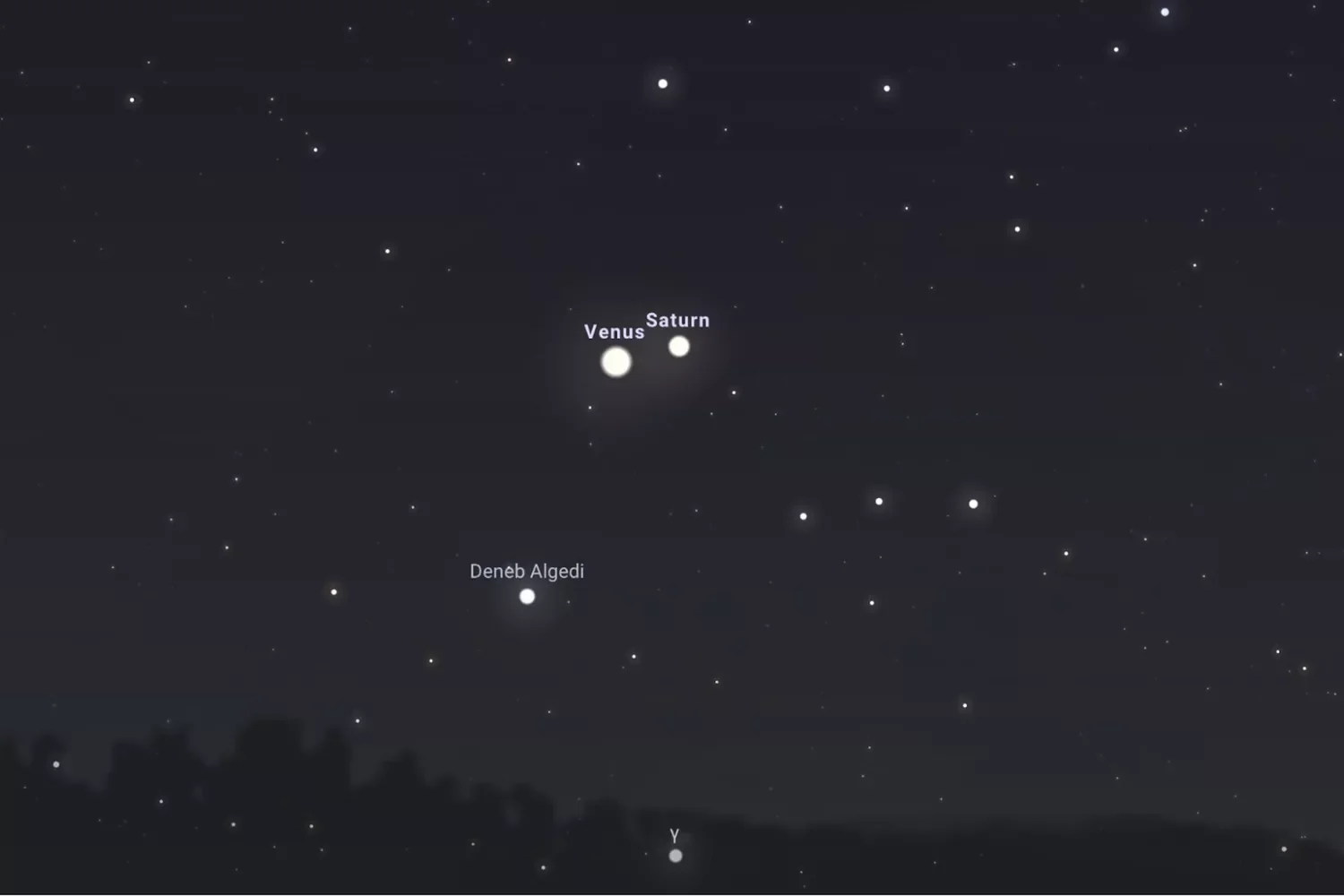
Venus and Saturn Draw Close in the Sky (Jan. 22)
Perfect for those who'd rather not stay up late, Venus and Saturn will stage a dinnertime show on the evening of January 22. Looking west-southwest around 6 p.m. EST, you'll see the two planets glide past each other less than a half degree apart. According to EarthSky, that gap is smaller than the diameter of a full moon!
The Moon and Mars Pass Exceptionally Close (Jan. 30-31)
Our final close encounter of January comes courtesy of Mars and the moon. On the evening of January 30-31, the moon and the red planet will draw remarkably close, with some locations on Earth—including much of the southern U.S.—witnessing an occultation (or eclipse) of Mars by the moon. This last occurred in December 2022, and the images captured by some astrophotographers of Mars "rising" behind the moon were nothing short of breathtaking. Look for this one to begin in the early morning hours of the 30th.
Looking Back: The Great Daylight Comet of 1910
Quite possibly the brightest comet of the 20th century, the Great Daylight Comet of 1910—also known as the Great January Comet or C/1910 A1—was first sighted in the Southern Hemisphere on January 12, 1910. Over the following days, the comet brightened dramatically, reaching a point where, by January 17, it could be spotted in broad daylight. Following its closest approach to the sun (perihelion), the comet became a sensation in the Northern Hemisphere's evening sky, shining five times brighter than Venus!
"So awe-inspiring was the scene," wrote John W. Bortle for Sky and Telescope in 2010, "that reportedly, thousands of persons in Portugal flocked to the coastline to view it, the religious repeatedly crossing themselves out of fear as they beheld the unworldly apparition suspended before them in the firmament."


References & Sources
- Primary source: https://www.treehugger.com/what-see-night-sky-january-2023-6979521
- Regional reference: Antarctic Ice Sheet geological survey.
- Cross-reference: Plate Puzzle archive, specimen GEO-378.
Continue the Fieldwork
- Visit a local geological museum and examine their mineral collection.
- Take a field notebook on your next hike and sketch the rock formations you see.
- Support organizations that protect fossil heritage sites from looting.
Specimen bookmarked for your next dig.