Celestial Highlights to Watch for in December's Night Sky
Field report
A close pass by Mars and a pair of dueling meteor showers bring the year to a sparkling close overhead.
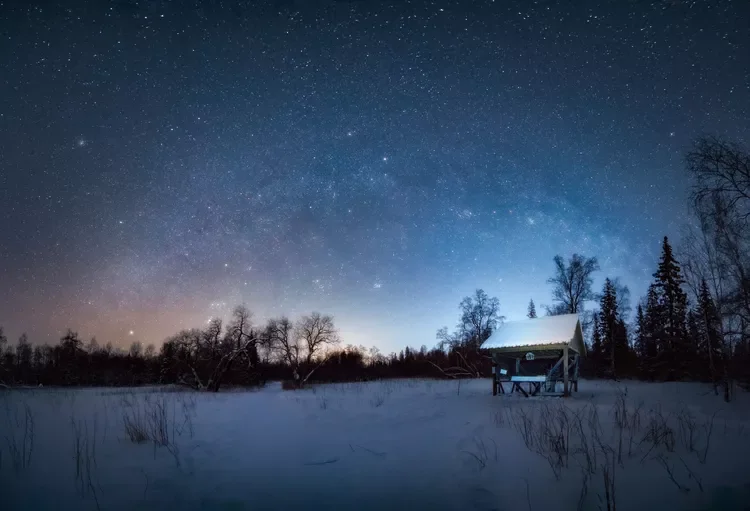
Sergey Egorov / Getty Images
The holiday season is barely underway, but the December sky has already assembled a gifts of its own to close out the year. Warm your gloves by the fire, pour a mug of hot chocolate, and step outside for a month of brilliant meteor showers, crisp stargazing, a close encounter with Mars, and the longest night of the year.
Did you know?
The Earth's inner core is a solid ball of iron-nickel alloy about 1,220 km in radius, with a temperature comparable to the surface of the Sun.
Mars Shines Brightest and Closest Until 2033 (Dec. 1)
If you have looked skyward over the past couple of months, you may have noticed the ruddy glow of Mars growing steadily brighter in the night sky. On December 1, the red planet reaches its closest, largest, and brightest approach to Earth, passing within 50.6 million miles. That is the nearest encounter since 2020 and one that will not be surpassed until June 2033.
Should clouds interfere, do not fret: Mars reaches opposition on December 8, with only a barely noticeable dip in size and brightness in between. In fact, the planet will gleam brilliantly throughout the month—at midnight on December 1, at its highest point above the horizon, it will even outshine Saturn. Grab a pair of binoculars, wheel out the telescope, and catch our nearest planetary neighbor at its finest.
Welcome the 'Cold Full Moon' (Dec. 7)
"The moon on the breast of the new-fallen snow,
Gave a luster of midday to objects below.
When what to my wondering eyes did appear,
But a miniature sleigh and eight tiny reindeer."
—'Twas the Night Before Christmas, Clement Clarke Moore
The Old Farmer's Almanac calls December's full moon the Cold Moon, but Indigenous peoples of North America also knew it as the Big Spirit Moon, the Blue Moon, or the Snow Moon. In New Zealand, where summer is just beginning, the Māori describe this lunar season as "Hakihea"—the time when birds are sitting in their nests.
Catch the Cold Moon in its full glory around 11:09 p.m. EDT on the evening of December 7.
Contemplate the Mysterious Geminids Meteor Shower (Dec. 14-15)
Among the most prolific meteor showers of the year, the Geminids deliver 120 to 160 shooting stars per hour—and they are also one of the most scientifically perplexing. Most meteor showers originate from comets shedding debris as they swing around the sun, but the Geminids trace back to an asteroid known as 3200 Phaethon.
NASA astronomers note that of all the debris streams Earth passes through each year, the Geminids' is by far the heaviest—outweighing other streams by factors of 5 to 500.
The puzzle is that Phaethon is simply not large enough to account for such an enormous debris field. Although it does shed some dust as it heats up near the sun, that material represents only about 0.01% of the total Geminid stream. The leading explanation is that Phaethon was once much larger and far more active, blasting far more debris into space in its distant past.
Researchers admit the mystery only deepens with each new finding about the shower.
To witness the display for yourself, look upward starting around 9 or 10 p.m. local time on December 14. The shower peaks near 2 a.m. local time, and although a waning gibbous moon will wash out the fainter meteors, brighter ones should remain visible through the rest of the week.
Celebrate the Winter Solstice (Dec. 21)
The winter solstice—that brief moment when the sun sits directly over the Tropic of Capricorn—arrives on December 21 at 4:47 p.m. EST.
For those of us shivering in the Northern Hemisphere, the solstice marks the longest night of the year, but it also carries the promise of growing daylight in the weeks ahead. Because the sun travels its lowest arc across the sky, the 21st is an ideal day to observe unusually long shadows. Your noontime shadow on the solstice is the longest it will cast all year—relish those elongated silhouettes while you can.
Catch the Ursids Meteor Shower (Dec. 21-22)
Though it follows the spectacular Geminids, the annual Ursids meteor shower can still deliver up to 10 shooting stars per hour. Some years even surprise astronomers with outbursts of 100 or more per hour. In 2022, even the faintest meteors should be visible, thanks to an approaching new moon that will keep skies appropriately dark.
The Ursids originate from debris shed by Comet 8P/Tuttle and appear to stream from the constellation Ursa Minor. Bundle up, settle in, and gaze skyward on the evening of the 21st or 22nd to catch the peak of this holiday-season shower.
A Galactic Festival of Lights Under a New Moon (Dec. 23)
Mirroring the twinkling string lights and candles below, the night sky puts on its own holiday display with the arrival of December's new moon. A new moon occurs when the illuminated side of the moon faces away from Earth, leaving the heavens free of moonlight and creating exceptional conditions for stargazing. Although the new moon peaks on December 23, dark skies will linger for several days afterward—plenty of time to break in any new telescope received as a holiday gift.

References & Sources
- Primary source: https://www.treehugger.com/what-see-night-sky-december-2022-6833756
- Regional reference: Himalayan Orogeny geological survey.
- Cross-reference: Plate Puzzle archive, specimen GEO-466.
Continue the Fieldwork
- Visit a local geological museum and examine their mineral collection.
- Take a field notebook on your next hike and sketch the rock formations you see.
- Support organizations that protect fossil heritage sites from looting.
Specimen bookmarked for your next dig.