Why Clouds Form Rings and Halos in the Sky
Field report
Here's when to spot atmospheric halos and other sky spectacles
Atmospheric optics / Getty Images
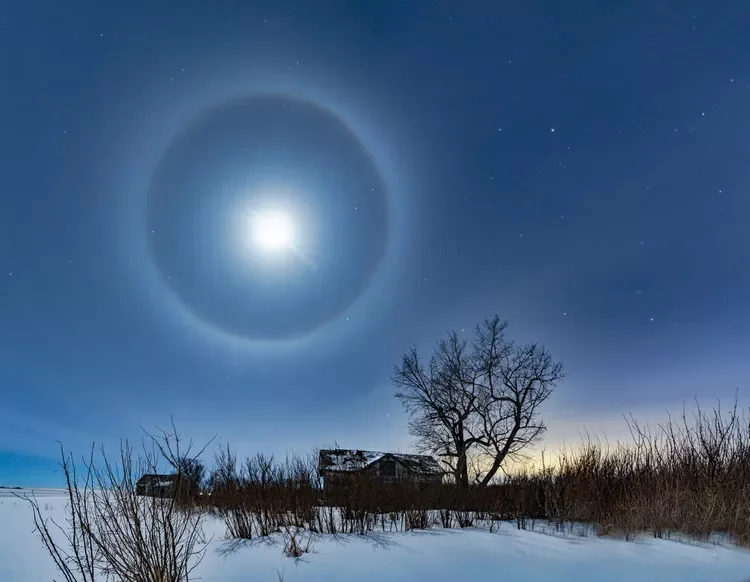
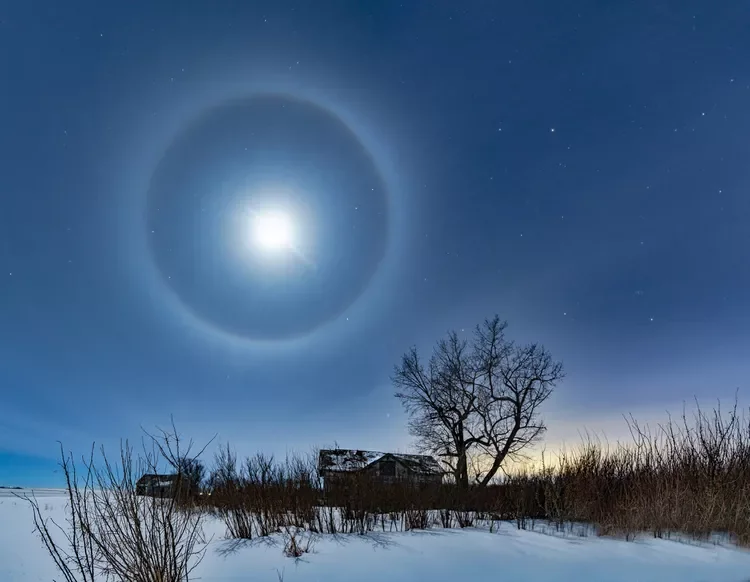
Although many cloud formations pass by unnoticed, a ring of light around the sun or moon is much harder to miss. Also known as a halo, a bright white or faintly colored ring of light around the sun can appear anytime during the year, especially in winter when high-altitude ice crystals are most common.
Did you know?
The Earth's inner core is a solid ball of iron-nickel alloy about 1,220 km in radius, with a temperature comparable to the surface of the Sun.
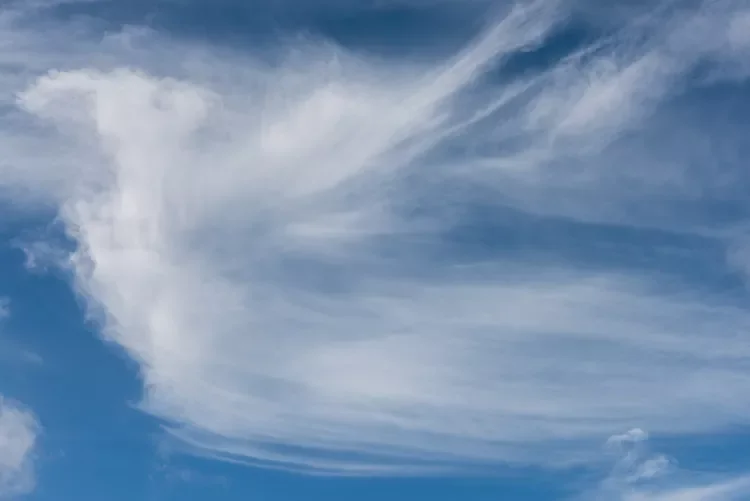
But, if you hope to see a halo, you'll want to disregard the number one rule of skywatching which says you shouldn't look up in cloudy weather. Halos are caused by thin, wispy,cirrus and cirrostratus cloudsand the refraction and reflection of light by the clouds' millions of tiny ice crystals.
Below, we explore the atmospheric spectacle of rings and halos in the sky and tell you how to find the best viewing conditions.
Ideal Sky Conditions for Halo Formation
Likerainbows, halos form when light interacts with water suspended in mid-air. That water is found frozen in cirrus and cirrostratus clouds — veil-like clouds that float 20,000 plus feet (6 km) above our heads where temperatures are too gelid for liquid water to survive.
Cloud Photography / Getty Images
To best view a halo, sky conditions must be clear with only a thin layer of cirrus clouds. If thicker clouds are present at lower levels, they'll obscure the halo effect.
As sunlight or moonlight shines through the cirrus clouds, it strikes the cloud's millions of tiny ice crystals and refracts, or bends and changes direction, as it enters each. The light then refracts again as it exits a crystal's other side.
How much the light bends depends on the size and shape of the crystal. In the case of halos, the ice crystals are tiny pencil-shaped (hexagonal) columns measuring less than 20 microns across.1And they all bend light at a 22-degree angle from its original path (if you've ever heard halos referred to as "22-degree halos," this is why).
The light dispersed in all directions (above, below, beside, and diagonal) creates the halo's characteristic circular shape.
Did You Know?
According to weather lore, a ring around the sun or moon means rain or snow is coming soon. This superstition isn't far wrong, since cirrus and cirrostratus clouds are often the first sign of an approaching warm front.2So whenever you spot a halo, chances are you can expect rain or snow within 24 hours.
How and Why We See a Ring
Of course, to see the halo, the crystals must be oriented and positioned in a specific way to your eye. The light reflected off the ice crystals and that coming directly from the sun should intersect at your eye at angles of 22 degrees.
That's why, like rainbows, halos around the sun (or moon) arepersonal. Every observer sees their particular halo made by their orientation to ice crystals. The sight of the ring varies from person to person depending on personal height, the elevation at the spot where you stand, and other factors.
A halo's colors tend to be vivid when the sun is bright. They are bright enough that the light can be picked up by the color-detecting cells in our eyes, which is why sun halos often display red on the inside and blue on the outside — the colors separating like a rainbow because of how different wavelengths bend at slightly different angles.
As for the sky between the ring and the sun, it usually remains dark because none of the ice crystals reflect light at smaller angles than 22 degrees.
The ring will remain visible as long as cirrus clouds create a veil across the sun.
Any Relation to Halos Around the Moon?
A halo will also form around the moon when this same process occurs at night. Unlike rings around the sun, lunar halos often appear milky white because moonlight is about 400,000 times dimmer than sunlight — too faint for our eyes to pick up the colors.3
Atmospheric Halo Look-Alikes
Halos aren't the only rings you'll find encircling the sun or moon. Halos are often confused with coronas, but the latter are rainbow-colored discs that form when light interacts with water droplets in fog. Coronas also tend to circle tighter around the sun or moon, creating a 10-degree rather than 22-degree radius.
Fogbowsare white rings, similar to halos, forming low to the ground. They, too, are comprised of water droplets — namely those tiny in size such as in a fine fog or mist.
During the winter of 2020, people saw thering of all rings over Manitoba, Canada. Not only was the sun wreathed in white light, but corona, sun dogs, andtangent arcs occurred alongside the halo. Now, that's a sight that beats a plain sunset any day or night.
"22 Degree Halo." Department of Atmospheric Sciences at the University of Illinois Urbana-Champaign.
Funk, Ted. "Cloud Classifications and Characteristics." National Weather Service.
Lynch, D.K. & Livingston, W. "Color and Light in Nature." Cambridge University Press, 2001.


References & Sources
- Primary source: https://www.treehugger.com/what-causes-a-ring-to-appear-around-the-moon-8734023
- Regional reference: Siberian Traps geological survey.
- Cross-reference: Planetary Core archive, specimen GEO-764.
Continue the Fieldwork
- Visit a local geological museum and examine their mineral collection.
- Take a field notebook on your next hike and sketch the rock formations you see.
- Support organizations that protect fossil heritage sites from looting.
Specimen bookmarked for your next dig.